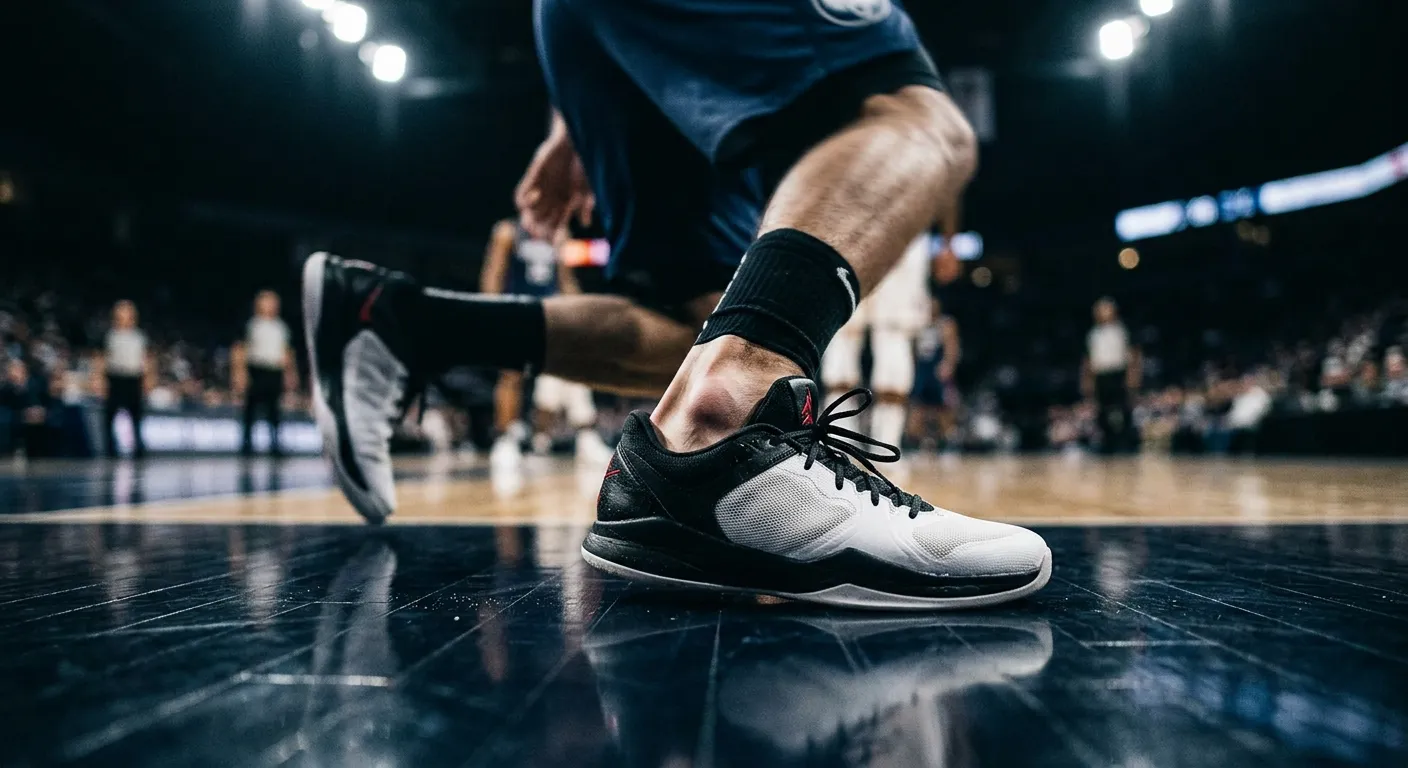
The injury everyone ignores until it costs them a season.
Most athletes roll an ankle, tape it, and play through it, until the same ankle starts giving way every few weeks and the tape stops helping.
Taped Up and Back on the Field
Ankle sprains are the most common injury in sports. They are also the most trivialized. The standard response (ice for a few days, wrap it, take some ibuprofen, play next week) is so universally accepted that most athletes do not even consider it an injury worth treating.
Here is the problem with that approach: 40% of athletes who sprain an ankle develop chronic ankle instability. That means repeated sprains, persistent feelings of the ankle “giving way,” and a cascade of compensatory problems that climb up the chain: knee pain, hip issues, altered running mechanics. All because nobody treated the first sprain like it mattered.
The first sprain is the window where that cascade gets prevented, and preventing it means rebuilding strength and control after the swelling settles, not reaching for a heavier tape job.
What Happens When You Ignore an Ankle Sprain
Every untreated ankle sprain starts a chain reaction. Here is how it unfolds.
Week 1
The Sprain
Lateral ligaments stretch or tear. Swelling, bruising, pain on the outside of your ankle. You ice it, maybe wrap it, probably skip a practice or two.
Week 2-3
The Early Return
The pain fades, the swelling goes down, and walking feels normal again, which reads as a green light to play. But ligament capacity, peroneal strength, and reactive control may still be underprepared for sport.
Month 2
The Re-Sprain
Same ankle, same mechanism, often worse this time, because the ligaments that never fully healed just got stretched again. You tape it heavier, brace it up, and play through it again. This is where chronic instability begins.
Month 3-6
Compensation Starts
Your body does not trust that ankle anymore. Without you realizing it, you shift weight to the other leg during cutting. Your landing pattern changes. Your hip starts working overtime to stabilize what the ankle cannot.
Month 6-12
Problems Up the Chain
Knee pain on the opposite side, hip tightness, shin splints, maybe a stress reaction. These problems are not always caused by an old ankle sprain, but lingering changes in loading and control can contribute.
The Alternative: Rebuild It
Proper ankle sprain rehab is not complicated. It is just rarely done. The ligaments need time to heal, and then the muscles around the ankle need to be rebuilt to do the job the ligaments alone cannot do.
This means peroneal strengthening (the muscles on the outside of your lower leg that actively resist inversion), calf strength, ankle proprioception under dynamic conditions, and progressive exposure to sport-specific movements (cutting, landing, pivoting) in a controlled environment before you do them at game speed.
Balance board work alone does not cut it, standing on a wobble board for 30 seconds is a starting point rather than a program. The ankle has to be trained under load, at speed, and in fatigue, because those are the exact conditions it rolled in.

What Ankle Rehab Should Include
Peroneal Strengthening
The muscles that resist ankle inversion. If these are weak, no amount of taping will compensate. We build them with progressive resistance training that goes well beyond band exercises.
Calf Complex Strength
Gastrocnemius and soleus both need direct work: eccentric loading, single-leg calf raises, and progressive plyometric loading to handle the demands of sprinting and jumping.
Dynamic Proprioception
Balance training under sport-relevant conditions: single-leg on unstable surfaces, reactive reaching, perturbation training, and eyes-closed variations that actually carry over to game situations.
Sport-Specific Return
Graduated cutting, landing, and pivoting drills that progressively challenge the ankle in the exact movements your sport demands. You do not go from "no pain at rest" straight to full practice.
Free phone consultation. No commitment, no insurance needed.
Already Dealing with Chronic Instability?
If you have sprained the same ankle multiple times, or if it regularly “gives way” during activity, you have chronic ankle instability. The ligaments have been stretched to the point where they no longer provide adequate passive restraint. This does not mean you need surgery.
Most cases of chronic ankle instability respond to aggressive strengthening and neuromuscular training. The goal is to build enough active stability (muscle strength and reflexive control) to compensate for the ligamentous laxity. Research shows that structured rehab programs resolve chronic instability in the majority of cases without surgical intervention.
The athletes who do not respond to conservative treatment and end up needing a lateral ligament reconstruction are the minority. But they exist. If you have done a real, progressive rehab program (not just balance board and band walks) and the ankle still gives way, surgical stabilization may be the next step, and we will be honest with you about that.
Frequently Asked Questions
Ankle Sprain Recovery
Stop taping over the problem.
Whether this is your first sprain or your fifth, an evaluation can show you where the ankle actually stands (strength, stability, control) and what a real rehab program looks like from there.
Book a Free Consult