
The hamstring strain that keeps coming back.
Hamstring strains have the highest re-injury rate of any muscle injury in sport. Usually because rehab stops at pain-free jogging instead of rebuilding the eccentric strength that sprinting demands.
The #1 Reason Hamstrings Re-Tear
The typical cycle goes like this: you strain the hamstring, rest it until the pain settles, test it with a jog that feels fine, then open up to a sprint a week or two later, and it fails at the same spot.
That cycle is so predictable that hamstring re-injury rates in professional sports hover around 30%. The reason is straightforward: athletes return to sprinting based on how the hamstring feels at low speeds instead of whether it can actually handle the forces of high-speed running.
During maximal sprinting, your hamstring undergoes extreme eccentric loading. It is lengthening while producing force at the same time, acting as a brake on your lower leg during the swing phase. The forces are enormous. And a hamstring that feels fine during a light jog has never been tested at anything close to those demands.
This is the gap that kills hamstring recoveries. The muscle heals enough to stop hurting, but it has not been loaded enough to handle the actual demands of your sport. The first time you open up to 90%+ effort, the weakest point fails.
What the Evidence Says About Hamstring Rehab
Myth
“My hamstring is tight. I need to stretch it more.”
Reality
Hamstring strains happen because the muscle is weak under load, not because it is short. In the acute phase (first 1-2 weeks), aggressive stretching can disrupt healing tissue and worsen the tear. Early management should prioritize pain-free movement and gradual eccentric loading over flexibility. Eccentric strengthening is the primary treatment.
Myth
“If I can jog without pain, I am ready to sprint.”
Reality
Jogging loads your hamstring at a fraction of sprint demands. The eccentric forces during maximal sprinting are 5-8x greater. A hamstring that tolerates a jog has not yet been tested against anything close to the loads that injured it.
Myth
“Rest until it feels better, then go back to playing.”
Reality
Rest allows initial healing but creates zero adaptation for the demands of sport. Without progressive loading, especially eccentric loading at increasing speeds, the muscle heals at a level that cannot tolerate competition.
Myth
“All hamstring injuries are the same.”
Reality
Proximal hamstring injuries (near the sit bone) and distal injuries (near the knee) involve different anatomy, different mechanisms, and require different rehab approaches. A sprinting-related biceps femoris tear is not the same injury as a yoga-related proximal tendinopathy.
Myth
“Nordic curls are all you need.”
Reality
Nordics are the best-supported single exercise for eccentric hamstring loading and injury-risk reduction, but a complete rehab also includes hip extension strengthening, single-leg work, progressive sprint loading, and sport-specific movement preparation.
Proximal vs. Distal
Where your hamstring is injured determines how we treat it.
Proximal Hamstring
Near the sit bone (ischial tuberosity)
Common in: Dancers, hurdlers, yoga practitioners, kickers
Mechanism: Excessive hip flexion with knee extension: deep stretching positions, high kicks, slides
Why it is tricky: Often a tendinopathy (degenerative changes in the tendon) rather than an acute tear. Sits on the bone you sit on, so daily activities aggravate it
Rehab focus: Isometric loading progressing to heavy slow resistance, hip extension strengthening, avoiding provocative stretching, gradual return to end-range activities
Timeline: Often 3-6 months for tendinopathies. These are slow healers that require patience
Distal Hamstring
Mid-belly or near the knee
Common in: Sprinters, soccer players, football players, baseball outfielders
Mechanism: High-speed running. The hamstring fails during the late swing phase when it is eccentrically loaded at near-maximal length
Why it is tricky: Feels fine at low speeds, fails at high speeds. Athletes feel “ready” long before they are. Scar tissue at the injury site is weaker than surrounding muscle
Rehab focus: Progressive eccentric loading (Nordics, Romanian deadlifts), hip extension power, structured sprint progression from 50% to 100% effort
Timeline: Grade 1: 2-4 weeks. Grade 2: 4-8 weeks. Grade 3: 8-16+ weeks. All with proper sprint progression before return
How We Rebuild It
Eccentric Loading Protocol
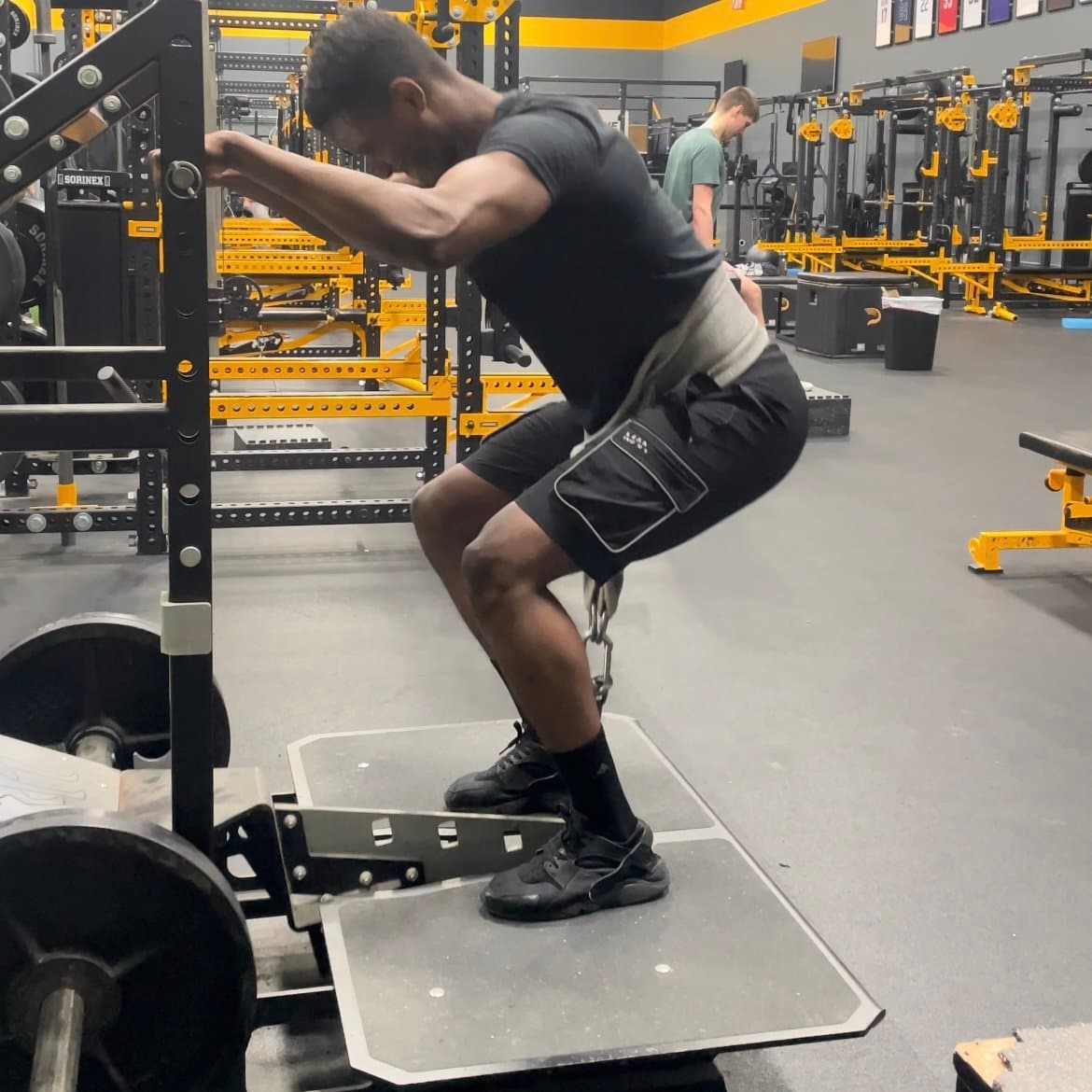
Nordics, Romanian deadlifts, slider curls. Progressive eccentric hamstring work that builds the muscle's capacity to handle high-speed lengthening. This is the foundation.
Hip Extensor Load Distribution
Your hamstrings share hip extension duties with the glute max. When the hip extensor system is underprepared, the hamstrings may take on more of the work. This can be one contributor to recurring overload. We test the full hip extensor system, then build the capacity needed for running and sport.
Structured Sprint Progression
Starting at 50% effort, progressing through 60%, 70%, 80%, 90%, and finally 100%. Each increment is earned by how the hamstring responds, not how it feels in the moment.
Sport-Specific Return
Sprinting in a straight line is step one. Acceleration, deceleration, change of direction, and sport-specific movements are the final test. You return to your sport, not just to running.
Free phone consultation. No commitment, no insurance needed.
Frequently Asked Questions
Hamstring Recovery
Break the re-injury cycle.
A second or third strain in the same spot usually means the last rehab ended before the eccentric strength and sprint progression work was finished. We build the program that finishes it, through a full season, not just back to jogging.
Book a Free Consult